
When enough people meditate together, measurable drops in crime, violence, and social unrest follow. Decades of peer-reviewed research have documented this startling phenomenon – here’s what the science says.
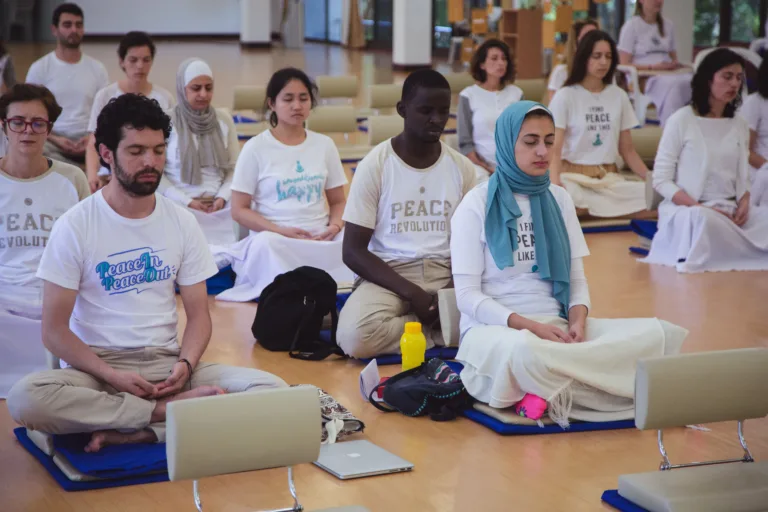
Group meditation assemblies are the foundation of the Maharishi Effect research.
What Is the Maharishi Effect?
The Maharishi Effect refers to the observed phenomenon in which a sufficiently large group practicing Transcendental Meditation (TM) or the advanced TM-Sidhi program together produces measurable improvements in the quality of life for surrounding populations. Named after Maharishi Mahesh Yogi, who first predicted the effect in 1960, it suggests that collective consciousness can influence social trends including crime rates, accident rates, hospital admissions, and even international conflict.
The core hypothesis is elegantly simple: just as individual meditation reduces stress in a single nervous system, group meditation creates a coherence in the collective consciousness of society – a kind of “field effect” that radiates calm and orderliness outward. This idea rests on a well-established principle in TM research: that individual practitioners show measurable reductions in cortisol, blood pressure, and anxiety. The Maharishi Effect extends this logic from the individual to the collective.
The core hypothesis is elegantly simple: just as individual meditation reduces stress in a single nervous system, group meditation creates a coherence in the collective consciousness of society – a kind of “field effect” that radiates calm and orderliness outward. This idea rests on a well-established principle in TM research: that individual practitioners show measurable reductions in cortisol, blood pressure, and anxiety. The Maharishi Effect extends this logic from the individual to the collective.
“Just as the quiet, settled state of the ocean gives rise to all the waves on the surface, the unified field of consciousness at the basis of all minds gives rise to all activity in society”. – Maharishi Mahesh Yogi
The One Percent Threshold for Transcendental Meditation
The original Maharishi Effect was observed when just 1% of a population practiced Transcendental Meditation. Researchers noted that in cities where 1% of residents had learned Transcendental Meditation, crime rates dropped significantly compared to matched control cities.
The first systematic study was published in 1976. Researchers analyzed 24 cities in the United States where 1% of the population had been taught TM by 1972. Compared to 24 matched control cities, the TM cities showed a 16% decrease in crime rate, while control cities showed an increase during the same period. The study was published in the Journal of Crime and Justice.
The matched-city methodology was critical to the study’s credibility. Researchers paired cities by population size, geographic region, and baseline crime rates, then tracked divergences over the period when TM adoption crossed the 1% mark. Follow-up analyses replicated the finding in 48 cities, strengthening the statistical case.
The first systematic study was published in 1976. Researchers analyzed 24 cities in the United States where 1% of the population had been taught TM by 1972. Compared to 24 matched control cities, the TM cities showed a 16% decrease in crime rate, while control cities showed an increase during the same period. The study was published in the Journal of Crime and Justice.
The matched-city methodology was critical to the study’s credibility. Researchers paired cities by population size, geographic region, and baseline crime rates, then tracked divergences over the period when TM adoption crossed the 1% mark. Follow-up analyses replicated the finding in 48 cities, strengthening the statistical case.
The Extended Maharishi Effect
When the more advanced TM-Sidhi program became available in the late 1970s, researchers discovered something remarkable: the square root of 1% of a population practicing the TM-Sidhi program in a group was sufficient to produce the effect. This is known as the Extended Maharishi Effect.
For a city of one million people, this means only about 100 practitioners meditating together could theoretically influence the entire population. For the entire world population of 8 billion, the number required is approximately 9,000 people – a strikingly small number relative to the scope of the predicted influence.
The square-root formula emerged from unified field theory analogies in physics, where the strength of a coherent signal scales as the square of the number of oscillators. Proponents argue that the TM-Sidhi program accesses a deeper, more unified level of consciousness than standard TM, amplifying the coherence effect nonlinearly.
For a city of one million people, this means only about 100 practitioners meditating together could theoretically influence the entire population. For the entire world population of 8 billion, the number required is approximately 9,000 people – a strikingly small number relative to the scope of the predicted influence.
The square-root formula emerged from unified field theory analogies in physics, where the strength of a coherent signal scales as the square of the number of oscillators. Proponents argue that the TM-Sidhi program accesses a deeper, more unified level of consciousness than standard TM, amplifying the coherence effect nonlinearly.
The Washington D.C. Group Meditation Experiment (1993)
Perhaps the most rigorously designed study of the Maharishi Effect took place in Washington, D.C. during the summer of 1993. A group of up to 4,000 TM-Sidhi practitioners gathered for an eight-week period from June 7 to July 30.
An independent review board of 27 scientists and civic leaders – including sociologists, criminologists, and representatives from the police department – approved the research protocol in advance, including the prediction that violent crime would drop. This prospective design was deliberate: by registering the hypothesis before the experiment began, researchers sought to eliminate accusations of post-hoc data mining.
The results were striking: HRA time series analysis showed a 23.3% reduction in violent crime (homicides, rapes, and assaults) during the peak period of the assembly. The probability that this result could be attributed to chance was less than 2 in 1 billion (p < 0.000000002). The analysis controlled for temperature, daylight hours, historical crime trends, and police staffing levels. The study was published in the peer-reviewed journal Social Indicators Research in 1999.
Notably, the crime reduction tracked the size of the group over time: as more meditators arrived each week, the drop in crime deepened, and when the assembly dispersed, crime rates returned to baseline – a dose-response pattern that strengthened the causal interpretation.
An independent review board of 27 scientists and civic leaders – including sociologists, criminologists, and representatives from the police department – approved the research protocol in advance, including the prediction that violent crime would drop. This prospective design was deliberate: by registering the hypothesis before the experiment began, researchers sought to eliminate accusations of post-hoc data mining.
The results were striking: HRA time series analysis showed a 23.3% reduction in violent crime (homicides, rapes, and assaults) during the peak period of the assembly. The probability that this result could be attributed to chance was less than 2 in 1 billion (p < 0.000000002). The analysis controlled for temperature, daylight hours, historical crime trends, and police staffing levels. The study was published in the peer-reviewed journal Social Indicators Research in 1999.
Notably, the crime reduction tracked the size of the group over time: as more meditators arrived each week, the drop in crime deepened, and when the assembly dispersed, crime rates returned to baseline – a dose-response pattern that strengthened the causal interpretation.
Global Peace Projects and Collective Consciousness
Throughout the 1980s and 1990s, several large-scale “peace assemblies” were organized to test whether group meditation could reduce international conflict through collective consciousness. The most extensively studied case focused on the war in Lebanon. Between 1983 and 1985, researchers organized seven separate group meditation assemblies and measured their effects on war intensity using daily data on war deaths, injuries, and conflict-related events compiled from news wire services.
The results, published in the Journal of Conflict Resolution (a Yale University journal), found that war deaths decreased by an average of 71% during the assemblies. The composite analysis also showed concurrent drops in war injuries (68%) and reductions in the overall intensity of conflict. Each assembly was analyzed independently and showed a consistent pattern: conflict measures decreased during the assembly period and returned to baseline afterward.
The results, published in the Journal of Conflict Resolution (a Yale University journal), found that war deaths decreased by an average of 71% during the assemblies. The composite analysis also showed concurrent drops in war injuries (68%) and reductions in the overall intensity of conflict. Each assembly was analyzed independently and showed a consistent pattern: conflict measures decreased during the assembly period and returned to baseline afterward.
How Could This Work? Theoretical Frameworks
Several theoretical frameworks have been proposed to explain the Maharishi Effect:
Theoretical frameworks | ||
|---|---|---|
Field Model of Consciousness Drawing parallels with quantum field theory, proponents suggest consciousness operates as a field that connects individuals. Coherence in this field – achieved through group meditation – could influence the behavior and experiences of the surrounding population. Physicist John Hagelin has argued that consciousness is identical to the unified field described by superstring theory, though this identification remains controversial. | ||
Stress Reduction Model Social stress is a well-documented driver of crime and conflict. If group meditation reduces collective stress through some mechanism of social influence, the downstream effects on antisocial behavior would follow naturally. This model has the advantage of not requiring exotic physics – it only requires that stress be socially transmissible, which sociological research supports. | ||
Quantum Coherence Hypothesis Some physicists have drawn analogies to the Meissner Effect in superconductivity, where coherent collective behavior at the quantum level expels disorder. Similarly, coherent group meditation might “expel” social disorder. Critics note that quantum effects typically do not scale to macroscopic social systems, though proponents point to emerging research in quantum biology as evidence that quantum coherence may operate at larger scales than previously assumed. | ||
Criticism and Controversy
The Maharishi Effect has faced significant skepticism from mainstream science. Critics raise several concerns:
Selection bias – Cities where TM is popular may differ from control cities in ways that independently affect crime. Confounding variables – Economic conditions, policing changes, and seasonal patterns are difficult to fully control. Mechanism – No known physical mechanism explains how meditating individuals could influence the behavior of non-meditating strangers at a distance. Institutional ties – Much of the research has been conducted by scientists affiliated with Maharishi International University, raising questions about researcher independence.
Supporters counter that many studies have used rigorous time-series analyses controlling for temperature, daylight hours, and other known confounders, and that the consistency of results across dozens of studies and varied locations is difficult to dismiss as mere coincidence. They also note that the D.C. study’s independent review board included non-affiliated scientists who endorsed the methodology, and that publication in mainstream peer-reviewed journals required passing standard editorial scrutiny.
Selection bias – Cities where TM is popular may differ from control cities in ways that independently affect crime. Confounding variables – Economic conditions, policing changes, and seasonal patterns are difficult to fully control. Mechanism – No known physical mechanism explains how meditating individuals could influence the behavior of non-meditating strangers at a distance. Institutional ties – Much of the research has been conducted by scientists affiliated with Maharishi International University, raising questions about researcher independence.
Supporters counter that many studies have used rigorous time-series analyses controlling for temperature, daylight hours, and other known confounders, and that the consistency of results across dozens of studies and varied locations is difficult to dismiss as mere coincidence. They also note that the D.C. study’s independent review board included non-affiliated scientists who endorsed the methodology, and that publication in mainstream peer-reviewed journals required passing standard editorial scrutiny.
EEG Coherence: Individual Evidence for Group Meditation
One line of evidence that lends indirect support to the Maharishi Effect comes from electroencephalography (EEG) research on individual TM practitioners. Studies have consistently shown that during TM practice, brain wave patterns become highly coherent – different regions of the brain begin oscillating in phase with one another, particularly in the alpha (8–12 Hz) frequency band.
This EEG coherence correlates with improved cognitive performance, emotional stability, and reduced anxiety. Proponents argue that if individual coherence produces measurable benefits at the personal level, then collective consciousness generated by a group of Transcendental Meditation practitioners could plausibly extend those benefits to the surrounding social environment. While this reasoning involves a significant logical leap, it provides a physiological basis for the claim that group meditation produces a qualitatively distinct state of brain functioning – not merely relaxation.
This EEG coherence correlates with improved cognitive performance, emotional stability, and reduced anxiety. Proponents argue that if individual coherence produces measurable benefits at the personal level, then collective consciousness generated by a group of Transcendental Meditation practitioners could plausibly extend those benefits to the surrounding social environment. While this reasoning involves a significant logical leap, it provides a physiological basis for the claim that group meditation produces a qualitatively distinct state of brain functioning – not merely relaxation.
Modern Relevance and Ongoing Research
Interest in the Maharishi Effect has seen a resurgence in recent years, fueled by growing mainstream acceptance of meditation’s individual benefits and increasing interest in collective well-being. Several universities continue to study the phenomenon, and permanent groups of advanced meditators have been established in India, the United States, and the Netherlands.
In 2023, a group of over 10,000 meditators assembled in Hyderabad, India – the largest such gathering to date – and researchers collected data on regional crime and hospital admission rates during the assembly period. Results from that study are pending peer review.
Whether one views the Maharishi Effect as a breakthrough in consciousness research or an extraordinary claim still awaiting sufficient evidence, it remains one of the most fascinating intersections of contemplative practice and social science – a bold hypothesis that challenges our assumptions about the boundaries of individual influence on collective reality.
In 2023, a group of over 10,000 meditators assembled in Hyderabad, India – the largest such gathering to date – and researchers collected data on regional crime and hospital admission rates during the assembly period. Results from that study are pending peer review.
Whether one views the Maharishi Effect as a breakthrough in consciousness research or an extraordinary claim still awaiting sufficient evidence, it remains one of the most fascinating intersections of contemplative practice and social science – a bold hypothesis that challenges our assumptions about the boundaries of individual influence on collective reality.
Experience The Effect Yourself
The research is compelling – but the real shift happens when you sit down and meditate. Whether you’re drawn to the science of collective consciousness or simply curious about what group meditation feels like from the inside, the best next step is direct experience.
Samavira’s free group meditations bring together meditators from around the world in live, guided group sessions – so you can explore the power of collective practice firsthand.
Enjoyed this article? Share it!
Facebook
Twitter
LinkedIn
WhatsApp
Email
Keep reading!

Ways to Deal With Discomfort and Pain
Many of us are going through the challenge of pain or discomfort on a daily basis. Depending on the severity, this can stop people from functioning normally and be very

5 Best Types of Music for Meditation
1. Ambient Music What It Is: Ambient music is a genre characterized by its atmospheric, immersive quality. It often features subtle melodies, slow tempos, and soothing sounds such as wind,

How Meditation Can Enhance Emotional Connection in Relationships
In recent years, meditation has gained widespread attention for its profound impact on personal well-being. But did you know it can also play an important role in strengthening relationships? This

Embracing Stillness: 4 Simple Meditation Techniques for Overcoming Cravings
Cravings can be relentless, whether you’re dealing with the urge to eat unhealthy foods, the pull of an addictive substance, or even the compulsion to overwork or engage in unhealthy

Sleep Better, Live Better: Meditation for Insomnia Relief
Insomnia affects millions of people worldwide, leading to various health issues such as fatigue, irritability, and a weakened immune system. One effective method to combat insomnia is meditation. This practice

Clarity Amidst Chaos: How to Use Meditation for Concentration and Focus
Let’s talk about why meditation for concentration and focus is important. Focus is a crucial aspect of daily life that allows individuals to concentrate their attention and energy on a
